
Compression Stockings Through an Omani Summer
Swelling does not take the summer off. What changes between November and June is how you manage heat, sweat and washing. Here is the routine.
Keep wearing them. The question comes up every year around May, and the honest answer is that swelling does not pause for the season — if anything, heat makes veins dilate and legs feel heavier by the afternoon. What a summer here really changes is the routine around the garment: when you put it on, which knit you choose, and how often you wash it.
Put them on before the day warms up
Your legs are at their thinnest first thing in the morning, before you have been upright for an hour. That is when a compression stocking is easiest to pull on and when it does the most good. Do it in a cool room, on dry skin, before the humidity makes your hands and the fabric stick to each other. If you shower first, dry your legs properly — damp skin and a tight knit are a difficult combination at any time of year and an impossible one in August.
If getting them on is the part you dread, that is a solved problem rather than a reason to give up: a slide or donning aid turns a five-minute struggle into a few seconds, and costs less than replacing a stocking you tore while fighting with it.
Choose a knit that suits the climate
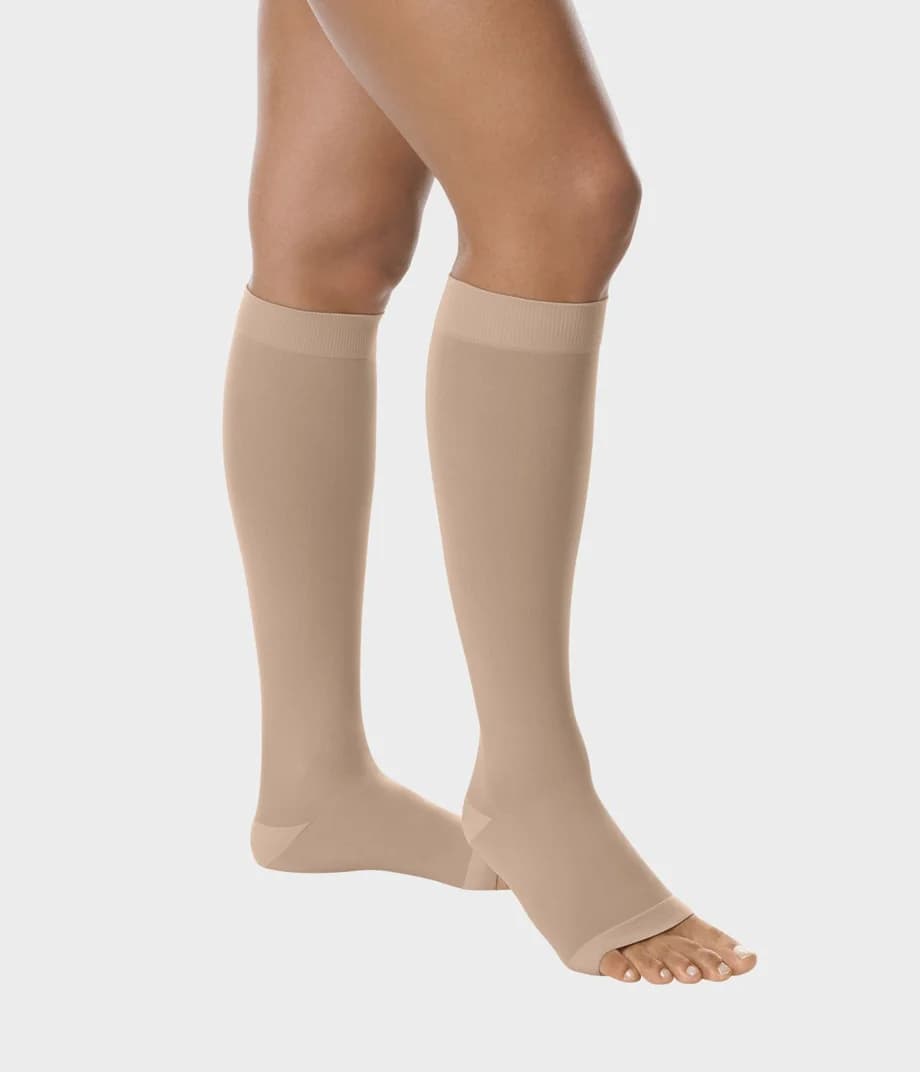
- Open toe. More air around the foot, easier to wear with sandals, and far more comfortable if your feet swell. The Juzo Basic below-knee stocking comes open-toe for exactly this reason.
- Cotton-blend knits. A cotton content sits better against skin that is damp for most of the day. The Dynamic Cotton below-knee stocking is the one to look at if a standard synthetic knit feels hot on you.
- Sheer, lighter constructions for daily wear under office clothes — the transparent daily range is thinner and less visible, and many people find it the only thing they will actually keep on through a Gulf summer.
- Two garments, not one. One on, one drying. This is not an upsell; it is the only way to wash daily without a gap, and two stockings worn alternately last longer than one worn every day.
Wash more often than you would in winter
Sweat, sunscreen and skin oils are what break down the elastane threads that give a stocking its pressure, and in a coastal summer you produce more of all three. Wash after every day of wear. Lukewarm water, a mild detergent, no fabric softener — softener coats the fibres and takes the stretch out of them. A mesh laundry bag on a gentle machine cycle is fine and is gentler than scrubbing by hand.
Dry in the shade, flat or on a line indoors. Not on a sunny balcony in July: direct sun and high heat do to elastane roughly what they do to a rubber band left on a dashboard. Never on a radiator, in a tumble dryer, or over a hot surface.
Sea, pool and sand
Salt water and chlorine both shorten the life of the knit. If you swim, keep a retired pair for the beach and rinse them in fresh water afterwards, or simply take the good ones off and put them back on when you are dry. Sand inside a compression stocking is also a genuine problem for anyone with fragile skin — shake it out before it has a chance to rub.
How to tell when a stocking is finished
Compression is not something you can see, so judge it by how the garment behaves:
- It goes on far more easily than it did when it was new.
- It slides down during the day, or the top band no longer grips.
- The knit looks creased, shiny or baggy around the ankle.
- Your legs feel the same at the end of the day whether you wore it or not.
Any one of those means the garment has stopped doing its job, and a stocking that has stopped working is not a lighter version of a working one — it is just a sock. Check the leaflet that came in the box for the service life the manufacturer gives, and replace it on that schedule rather than waiting for it to look worn out.
If your legs get worse over the summer
Heavier legs in the heat are ordinary. New or sudden swelling in one leg only, pain in the calf, skin that is hot, red, broken or changing colour, or an open sore are not — those are reasons to see a doctor rather than to adjust your laundry routine. Compression supports a diagnosis; it does not replace one.
Not sure which knit or class suits your summer, or whether your current pair still has life in it? Send us a message on WhatsApp, or browse the vein care range. Delivery is 4 OMR anywhere in Oman and free over 50 OMR, usually within five working days.
Our certified specialists can guide you to the correct compression class and garment.
Talk to a specialistRelated articles
Comments
…