
On Your Feet All Day: Which Compression Class?
Aching legs after a shift on your feet? Class 1 below-knee is where most people start. How to tell the classes apart, and how to measure.
For aching, heavy legs at the end of a long shift on your feet, a class 1 below-knee stocking is the usual starting point. For legs with visible varicose veins, skin changes, swelling that is still there in the morning, or a history of a clot, the answer is class 2 — and that is a decision to take with a doctor, not from a product page.
Teachers, nurses, pharmacists, shop and restaurant staff, barbers, security staff, anyone who spends a shift standing on a hard floor: this is the most common reason people in Oman start looking at compression at all, and it is also the easiest one to get right.
What the classes actually mean
Medical compression is graduated — tightest at the ankle, easing as it goes up the leg — and the classes describe how firm that pressure is.
- Class 1 is the lighter everyday class. It is the one for tired, heavy, aching legs, mild swelling by evening, long days standing or sitting, and pregnancy. You can buy it without a prescription and most people get used to it within a few days.
- Class 2 is noticeably firmer. It is what doctors generally prescribe for established varicose veins, swelling that persists overnight, lymphoedema or lipoedema, after vein surgery, and after a deep vein thrombosis. It is harder to put on, which is why a donning aid is worth having with it.
- Class 3 exists and is prescribed for more severe venous disease. Nobody should be choosing it for themselves.
Firmer is not better. A class 2 stocking bought because it sounded more serious is a stocking you will take off at eleven in the morning, and the one you are not wearing does nothing at all.
Below knee or thigh high?
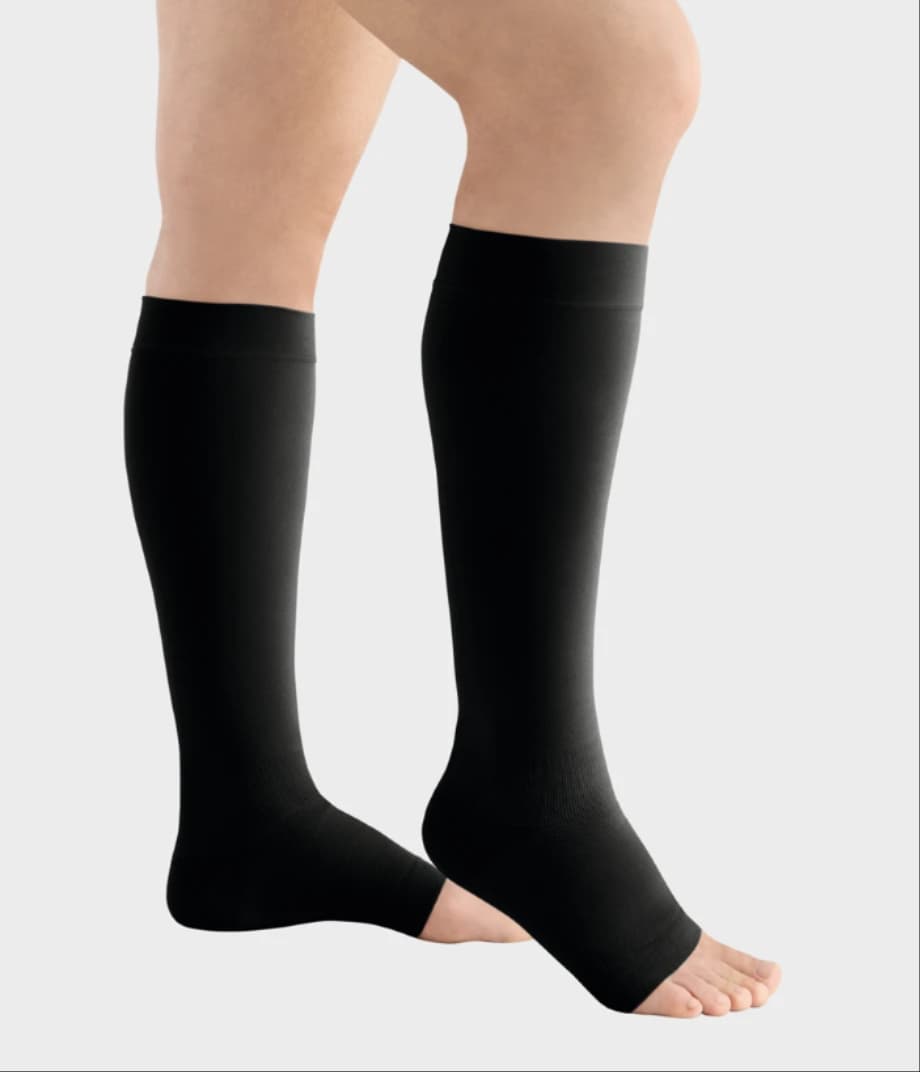
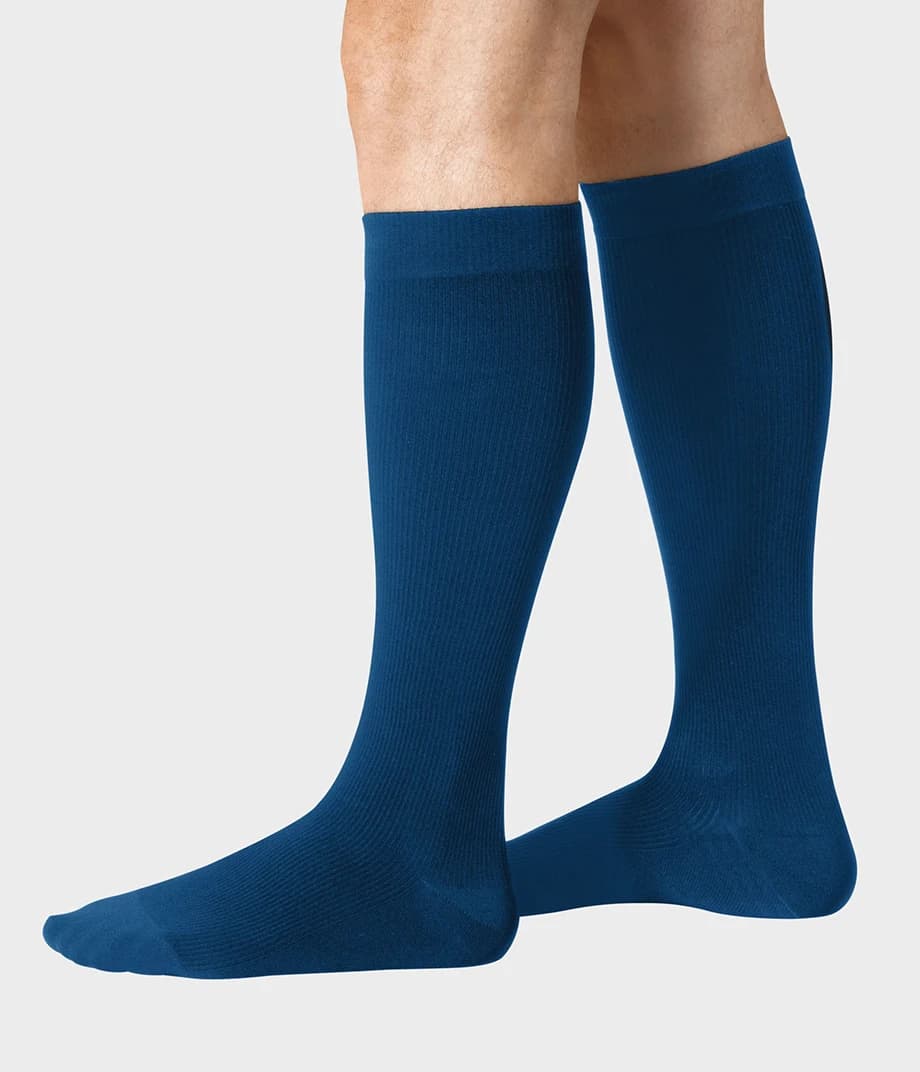
For work-day leg fatigue and swelling that stops at the calf, below-knee is right and is what most people stay with. It is cooler, far easier to put on, and stays where it is put. The Move below-knee stocking and the Basic below-knee stocking are both everyday, durable knits of exactly this kind.
Thigh-high or tights make sense when the swelling or the veins extend above the knee, after certain vein procedures, or in pregnancy — and they are a fitting question, because a thigh-high that slides down all day is worse than a knee-high that stays up. Look at the vein care range for both lengths, and ask before you commit to the longer one.
Measure in the morning, before you stand up for the day
Size in compression is not your shoe or clothes size. It comes from a few measurements in centimetres, and they have to be taken when your legs are at their smallest — within a few minutes of getting out of bed, not after a shift.
- Ankle: the narrowest point, just above the ankle bone.
- Calf: the widest point of the calf.
- Length: floor to the bend of the knee, sitting with the knee at a right angle.
Take them with a soft tape, snug but not pulled tight, and write them down for both legs — they are often not the same. If you are between sizes, or the two legs disagree, send the numbers to us on WhatsApp before ordering rather than guessing.
See a doctor first if any of this applies
Compression is safe for most people, but not for everyone, and some symptoms need a diagnosis before anything is pulled on:
- Sudden swelling in one leg, especially with calf pain, warmth or redness — that needs same-day medical attention.
- An open sore, broken skin or a wound on the leg.
- Known arterial disease, or cold, pale, painful feet.
- Diabetes with reduced sensation in the feet, where a poorly fitting garment can do damage you will not feel.
- Heart failure, or any condition for which you have been told to be careful with your circulation.
In those situations a doctor decides whether compression is appropriate and which class — and if it is, the ulcer-care systems and the firmer knits exist for exactly that, under supervision.
Making a stocking survive a real shift
Put them on before you leave home. Keep your skin moisturised at night, not in the morning — lotion under a stocking makes it slip and shortens the life of the knit. Change your standing posture when you can, shift your weight, and use the few seconds you get sitting down to flex your ankles. And have a second pair so one is always clean: a stocking washed daily keeps its pressure longer than one worn three days running.
If you are starting out, the durable everyday knits are the ones built for being worn hard, every working day. Tell us what your day looks like and we will tell you honestly which class and length fits it.
Our certified specialists can guide you to the correct compression class and garment.
Talk to a specialistRelated articles
Comments
…